
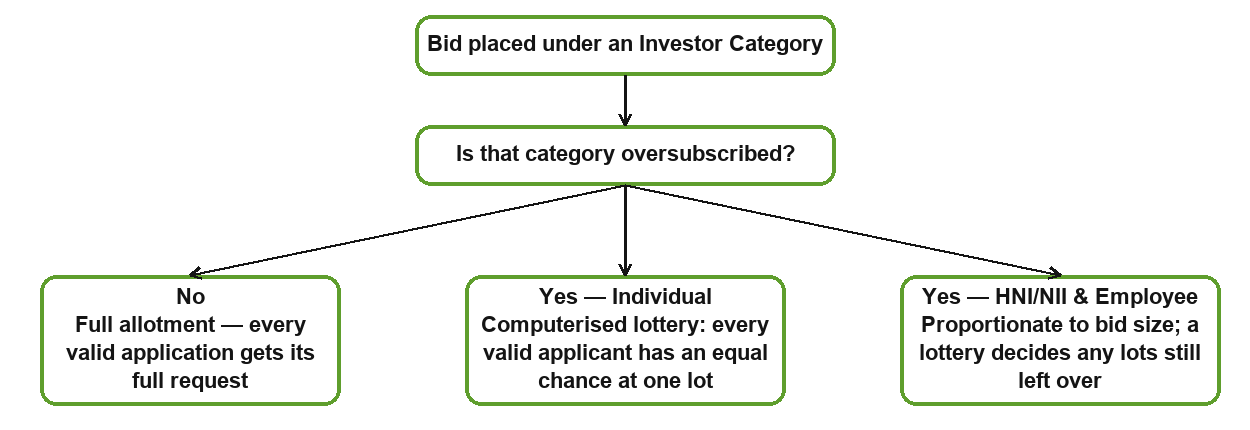
When an IPO is oversubscribed, each investor category is allotted separately, from its own reserved pool of shares — and the method depends on the category. Individual applications go into a computerised lottery where each valid applicant has an equal chance at one lot. HNI/NII and Employee applications are allotted proportionately, based on the size of each bid relative to the shares reserved for that category.
Why does allotment split by category at all?
Once you place a bid, it's grouped with every other bid in the same investor category for that IPO. Every IPO reserves a fixed portion of its shares for each investor category — Individual, HNI/NII, Employee (where offered), and QIB (Qualified Institutional Buyers, who apply through a separate institutional process, not from the Rupeezy app). Each category's reserved shares are allotted only among applicants in that category, against that category's own subscription — so one category being heavily oversubscribed doesn't affect allotment odds in another.
How Individual category allotment works
If the Individual category is oversubscribed, shares aren't split into smaller pieces across every applicant. Instead, the shares reserved for the category are divided into lots of the minimum bid size, and a computerised lottery decides which applicants get one lot each — so as many unique applicants as possible receive an allotment, rather than everyone receiving a fractional, unusably small quantity. An application either wins a lot in the draw or doesn't; bidding above the cut-off price or applying earlier doesn't change your odds (see "Can I improve my IPO allotment chances?" for more on what does and doesn't help).
How HNI/NII and Employee allotment works
Shares reserved for the HNI/NII and Employee categories are allotted proportionately — each valid bid gets a share of the reserved pool in proportion to its bid size, rather than an equal-odds draw. If the category is oversubscribed heavily enough that even a proportionate split would leave some applicants with less than one full lot, the remaining lots are decided by a lottery among those applicants, the same way the Individual category works.
What if the IPO isn't oversubscribed?
Every valid application gets its full requested allotment — the lottery and proportionate methods only come into play once demand in a category exceeds the shares reserved for it.
Things to keep in mind
- Allotment is decided per category, not for the issue as a whole — check the subscription figure for the category you actually applied under, not the overall number.
- None of this depends on which broker you applied through — Rupeezy forwards every bid to the exchange and the Registrar and Transfer Agent (RTA), who run the same lottery/proportionate process for all applicants in a category regardless of broker.
- You can track exactly where your own application stands under IPOs > Applied — see "How to check the IPO bid and allotment status?"