
A gap-up is when a stock opens the day at a price clearly above the previous day's close; a gap-down is an open clearly below it. On the chart it appears as empty space between yesterday's candle and today's. A price range where no trading happened at all.
Why do gaps happen?
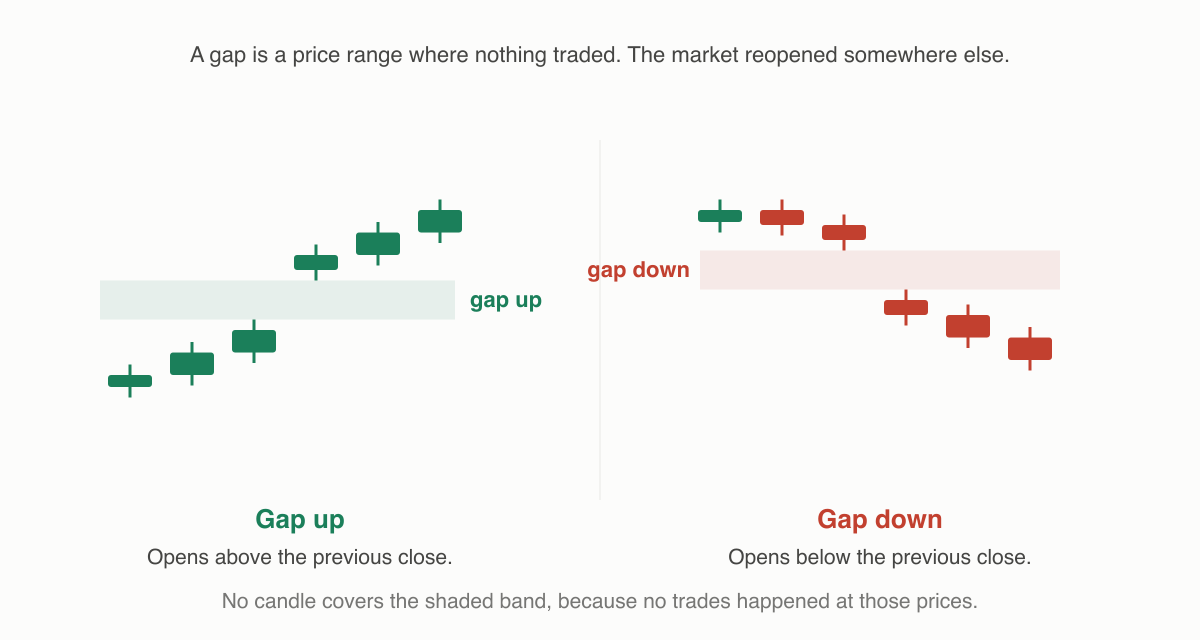
Because the market is closed far longer than it is open, but the world doesn't stop. Between one day's close and the next day's open, quarterly results land, global markets move, and company or policy news breaks. All of that pent-up information has to be priced in at once when trading resumes.
The mechanism that does the repricing is the morning pre-open session, where exchanges collect buy and sell orders before continuous trading begins and compute a single opening price that balances them. If the news was good, that discovered price sits above yesterday's close and the stock gaps up; if bad, it gaps down. The full mechanics are in what is the special pre-open session.
Concretely: Bharat Paints Ltd closes Tuesday at ₹520. That evening it reports a quarter well ahead of expectations. Wednesday morning, buy orders flood the pre-open, and the discovered opening price is ₹551, a gap-up of ₹31. Nobody got to trade at ₹521–₹550; the market simply repriced across that zone. Sunita, holding from ₹500, sees her profit jump without a single share trading in between. Of course, the same mechanism works against holders on bad news. A gap-down skips past every price on the way down too, which is why gaps are a real risk for overnight positions: a stop-loss order cannot execute inside a gap, only at the next traded price beyond it.
How do chart readers classify gaps?
Traders sort gaps by where they occur, and read each type differently:
| Type | Where it appears | Often interpreted as |
|---|---|---|
| Common gap | Inside a quiet range | Routine noise; frequently "fills" |
| Breakaway gap | Jumping out of a long range or level | A decisive repricing starting a move |
| Runaway gap | Mid-trend | The existing trend accelerating |
| Exhaustion gap | After a long, stretched move | A final burst before the move tires |
"Gap fill" is the phrase you'll hear most: price later trading back through the gap zone. It happens often enough that "gaps always fill" became a market cliché, but it's a cliché, not a law. Some gaps fill the same day; some, like a genuine breakaway above old resistance, never fill at all. Note also that these four labels are mostly assigned confidently in hindsight; live, on the morning itself, a breakaway and an exhaustion gap can look identical.
Traders typically read gaps alongside volume: a gap on heavy volume is read as broad repricing, a thin-volume gap as more fragile. Very large gaps can also interact with a stock's daily circuit limits or price bands, which cap how far a price may move in a day.
Things to keep in mind
- Gaps are the market repricing overnight information at the open, normal, frequent, and unavoidable for overnight holders.
- A stop-loss does not protect you inside a gap; it triggers at the next available price, which can be far beyond your trigger.
- "Gaps always fill" is folklore. Many do; plenty don't, and none on a schedule.
- Gap classifications (breakaway, exhaustion, etc.) are far easier to assign in hindsight than in real time. Treat morning readings as provisional.