
You can invest in Government Securities on Rupeezy Web (Dock). Go to Bids, open the G-Sec tab, pick a Treasury Bill or G-Sec and tap Apply. Your order is placed with the exchange before the cut-off, and you can track it under the Applied tab.
How to place a G-Sec / T-Bill order
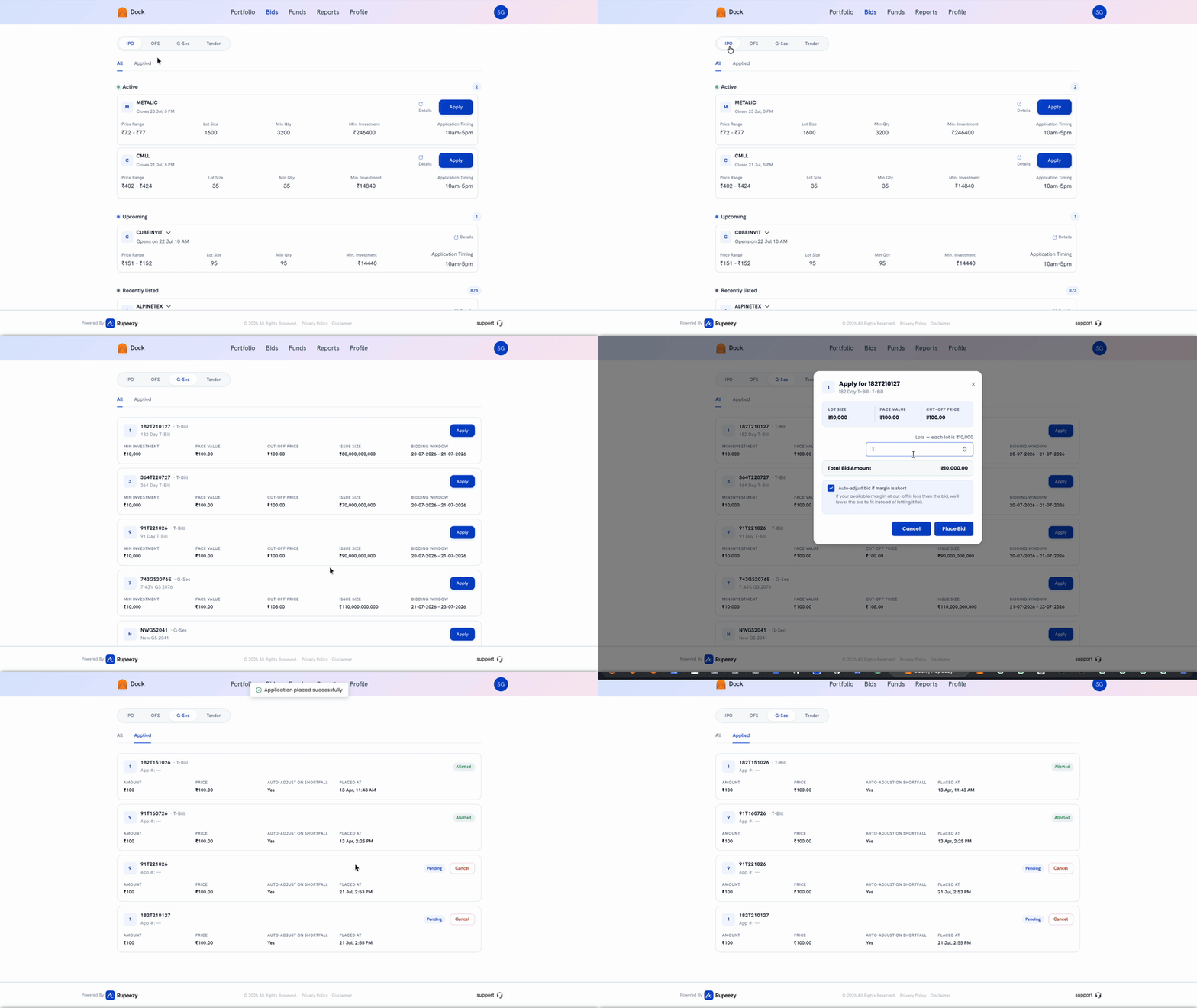
- Open Dock and go to Bids.
- Switch to the G-Sec tab — you will see the available Treasury Bills and G-Secs, each with its Min Investment, Face Value, Cut-off Price, Issue Size and Bidding Window.
- Tap Apply on the security you want and enter your amount — from ₹10,000 and in multiples of ₹10,000.
- Your application is submitted — it appears under the Applied tab.
How is the price and allotment decided?
Government Securities are sold through an auction, and as a retail investor you apply under non-competitive bidding — you enter an amount, not a price. You are then allotted at the weighted-average price the auction settles at. Because of this:
- You do not quote a price when you apply.
- Allotment is not guaranteed — if the auction is oversubscribed, you may be allotted less than you applied for, or nothing at all.
- For a T-Bill, that weighted-average price is below the ₹100 face value, which is why the discount is refunded to you after allotment (see below).
Under the RBI non-competitive bidding scheme, you can apply for ₹10,000 up to ₹2 crore (face value) in a single auction.
When is the cut-off to apply?
Each security shows a Bidding Window (a date range). You can apply, modify or cancel your order up to about one hour before the exchange's cut-off on the last day of that window. After that, your order is locked and we place it with the exchange (NSE) in the final hour. The exact cut-off time depends on the specific security.
What is "Auto-adjust on shortfall"?
If you turn this on and your available funds are less than needed at the cut-off time, your order is reduced to the amount you can afford instead of being rejected — as long as it stays above the minimum. If it is off, an order that can't be fully funded at cut-off is rejected.
When is my money debited, and when do I get a refund?
You need the full amount for your order in your ledger upfront. For a Treasury Bill, one lot requires the full face amount — for example ₹10,000 — which is debited from your ledger when your bid is placed with the exchange.
- If your order is allotted: a T-Bill is bought at a discount to its face value, so the discount is refunded to your ledger. For example, on a ₹10,000 order you may get around ₹300 back, so your net cost is only the discounted price.
- If your order is not allotted: the full amount is refunded.
Either way, refunds are credited back to your ledger by T+2 (within two working days).
How do I track or cancel my order?
Open the Applied tab. Each order shows its Amount, Price, Placed-at time and Status (for example Pending, then Allotted or Not allotted). While an order is Pending, you can Cancel it. Once it has been placed with the exchange, it can no longer be modified or cancelled.